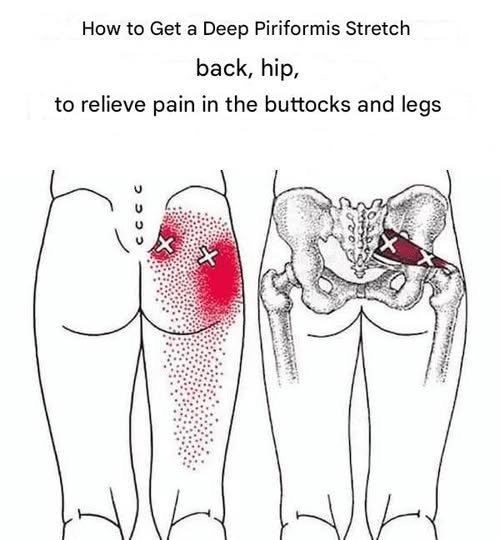
Here’s how to get a deep piriformis stretch that actually works 👇
The Best Deep Piriformis Stretch (Figure-4 / Reclined Version)
This version is gentle on the spine and lets you control depth.
How to Do It
-
Lie on your back with both knees bent and feet flat on the floor.
-
Cross your right ankle over your left thigh, just above the knee (forming a “4”).
-
Flex your right foot to protect your knee.
-
Reach your hands behind your left thigh and gently pull the leg toward your chest.
-
Keep your lower back relaxed against the floor—no arching.
-
Hold for 30–60 seconds, breathing slowly.
-
Switch sides.
What You Should Feel
-
A deep stretch in the glute of the crossed leg
-
Possible release through the hip and outer thigh
-
No sharp pain or knee discomfort
Make It Deeper (Without Hurting Yourself)
Try these small adjustments:
-
Exhale slowly as you pull the leg in—your body releases tension on the breath.
-
Gently press the crossed knee away from your chest with your elbow.
-
Add a subtle rock side to side to find tight spots.
Seated Piriformis Stretch (Great for Work or Travel)
-
Sit tall with feet flat on the floor.
-
Cross one ankle over the opposite knee.
-
Keep your spine straight and hinge forward at the hips.
-
Stop when you feel the stretch in your glute.
-
Hold 30–45 seconds per side.
Tip: If your back rounds, you’ve gone too far.
How Often to Stretch
-
Daily if you have chronic pain or sciatica-like symptoms
-
After workouts involving legs or glutes
-
Before bed to reduce nighttime hip and leg pain
Important Safety Notes
-
Never force the stretch—deep doesn’t mean aggressive
-
Stop if pain travels sharply down the leg
-
If symptoms persist or worsen, consider seeing a physical therapist (piriformis issues often involve nerve irritation)
If you want, I can also show you strength exercises that keep the piriformis from tightening back up—or help you figure out if your pain is actually piriformis vs. true sciatica.